Notes from the 91APP AgentOne Launch: When Retail SaaS Starts Doing the Work Itself
A brand looked at its own data on stage and found 630,000 people who had signed up as members and never bought a single thing. That number is the whole argument for agentic retail, and it is probably sitting in your database too. Here are my notes from the 91APP AgentOne launch.

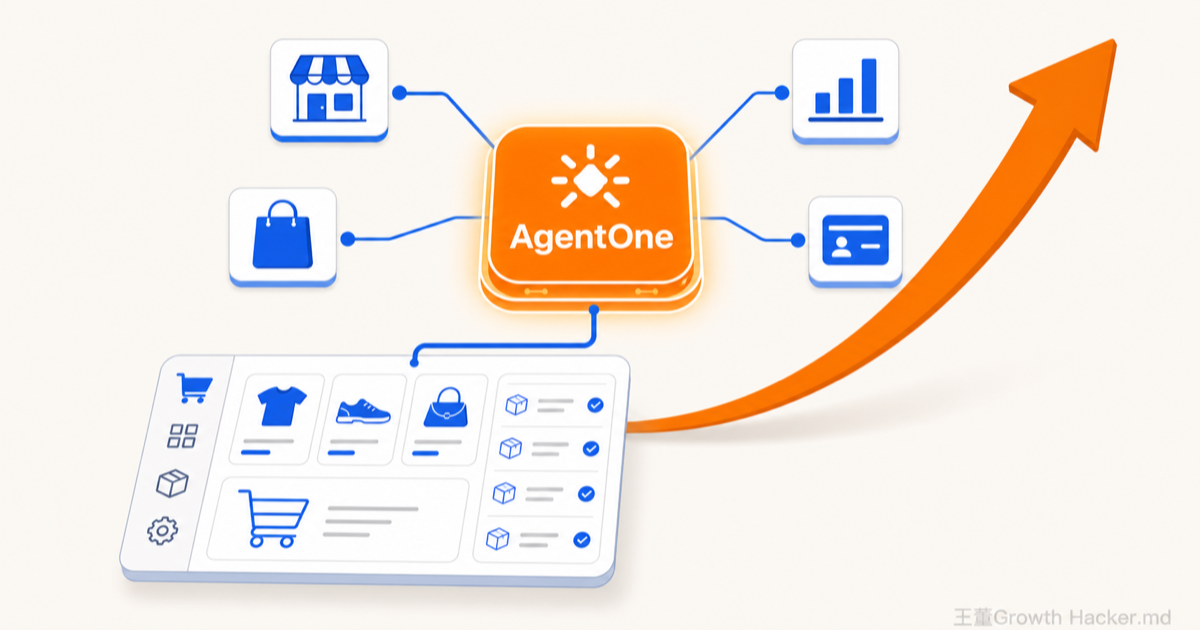
Quick note before we start. This is the English edition of a piece I published in Mandarin on 23 July 2026. The original is here: 91APP AgentOne 現場直擊 (in Mandarin). Same event, same notebook, rewritten for readers who don't work in the Taiwan market.
A few days ago I went to 91APP's product launch at the 2026 Retail Summit, one of Taiwan's bigger retail industry gatherings. 91APP is the retail SaaS platform a large slice of Taiwanese brands run their store, membership and OMO on.
I laughed the moment I walked in. Full house, lights down, first slide up, and half the room raised a phone at the same time. You know that reflex: this deck will be useful later, so shoot first, read later. I took close to thirty photos myself, and only when I sorted my notes did I realise how dense the morning had been.
So these are my field notes, plus the reactions of someone who spent years in traditional manufacturing, ran a leased counter inside a department store, then moved into digital marketing and ecommerce.
Conclusion first. On the surface this was a launch for a product called AgentOne. What it was actually about is one thing:
Once your ecommerce backend starts doing things on its own, the retail playbook has to change.
Two speakers. One walked through the product skeleton (the slides gave the name Happy Lee). The other explained how all of it collapses into growth. I've merged them here, because they were always two sides of the same argument.
The skeleton: AgentOne's three foundations
Lee opened by putting the core claim in the plainest language possible: it knows you.
Knows you how? Three foundations.
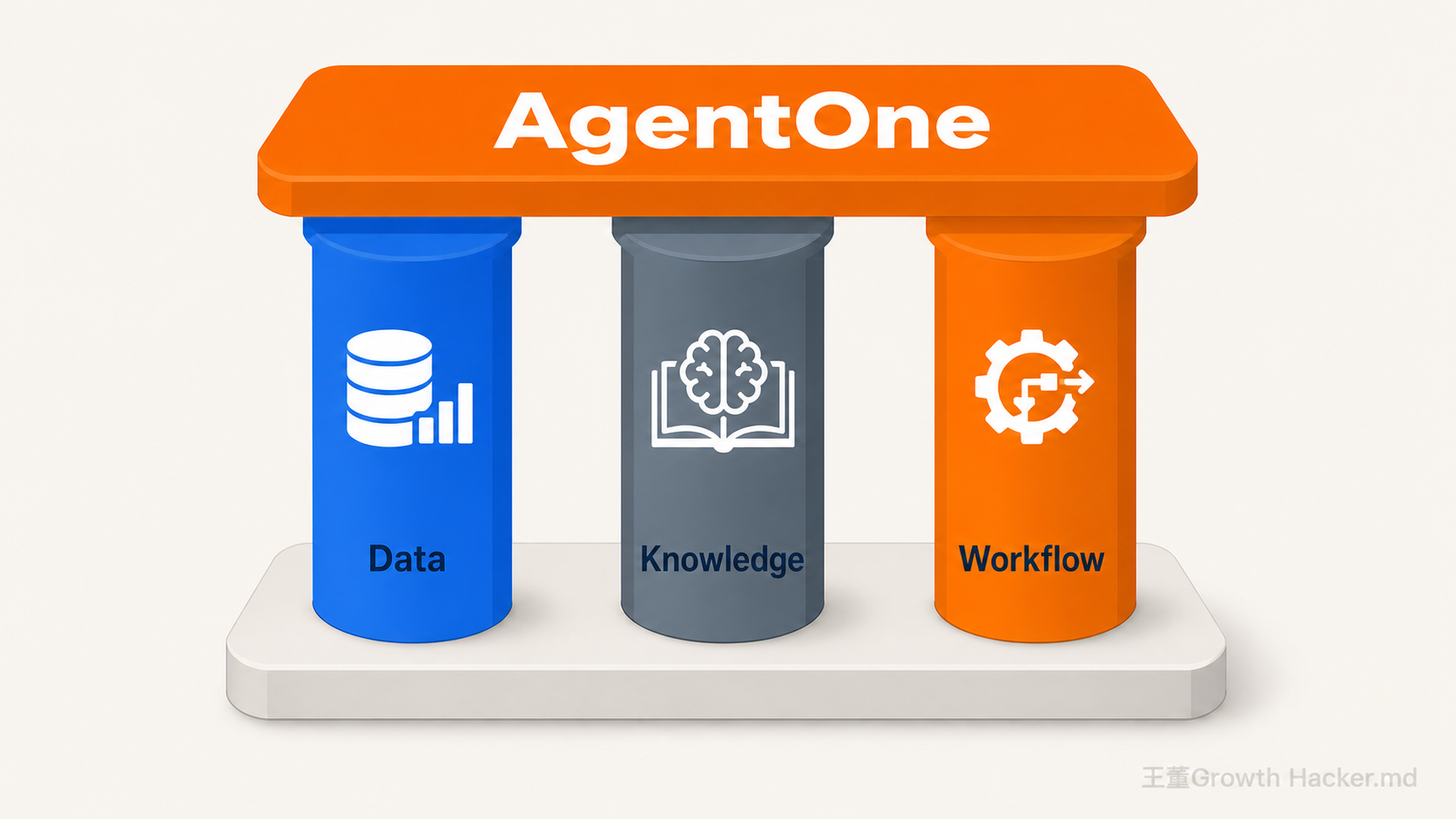
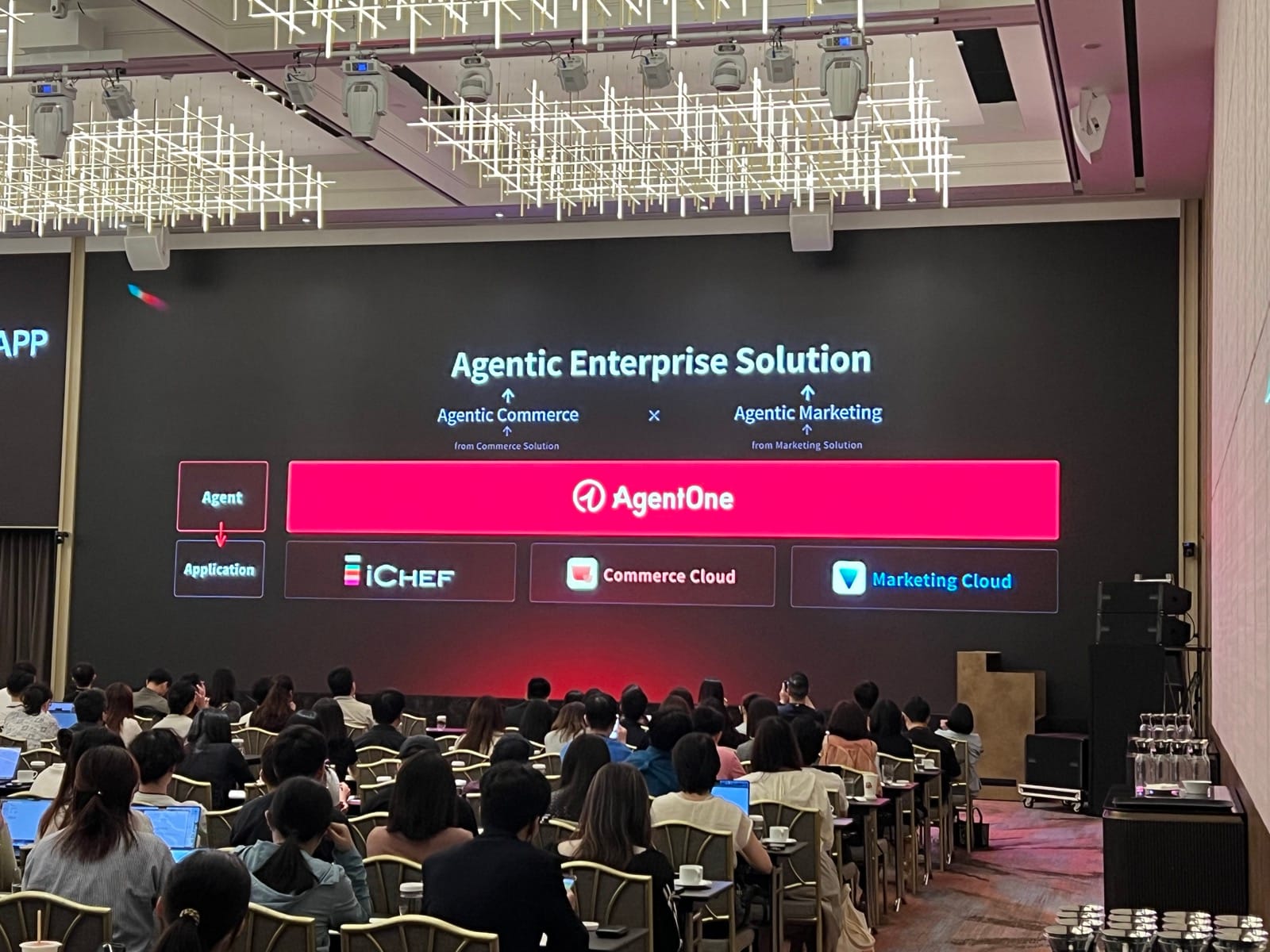
Data is your operating numbers, so it knows what shape the business is in. Knowledge is the product know-how 91APP and iCHEF have accumulated over more than a decade, plus the know-how of growing brands with it. Workflow is where it grows hands and feet: it reaches into Commerce Cloud, Marketing Cloud and iCHEF and actually operates them to finish the job.
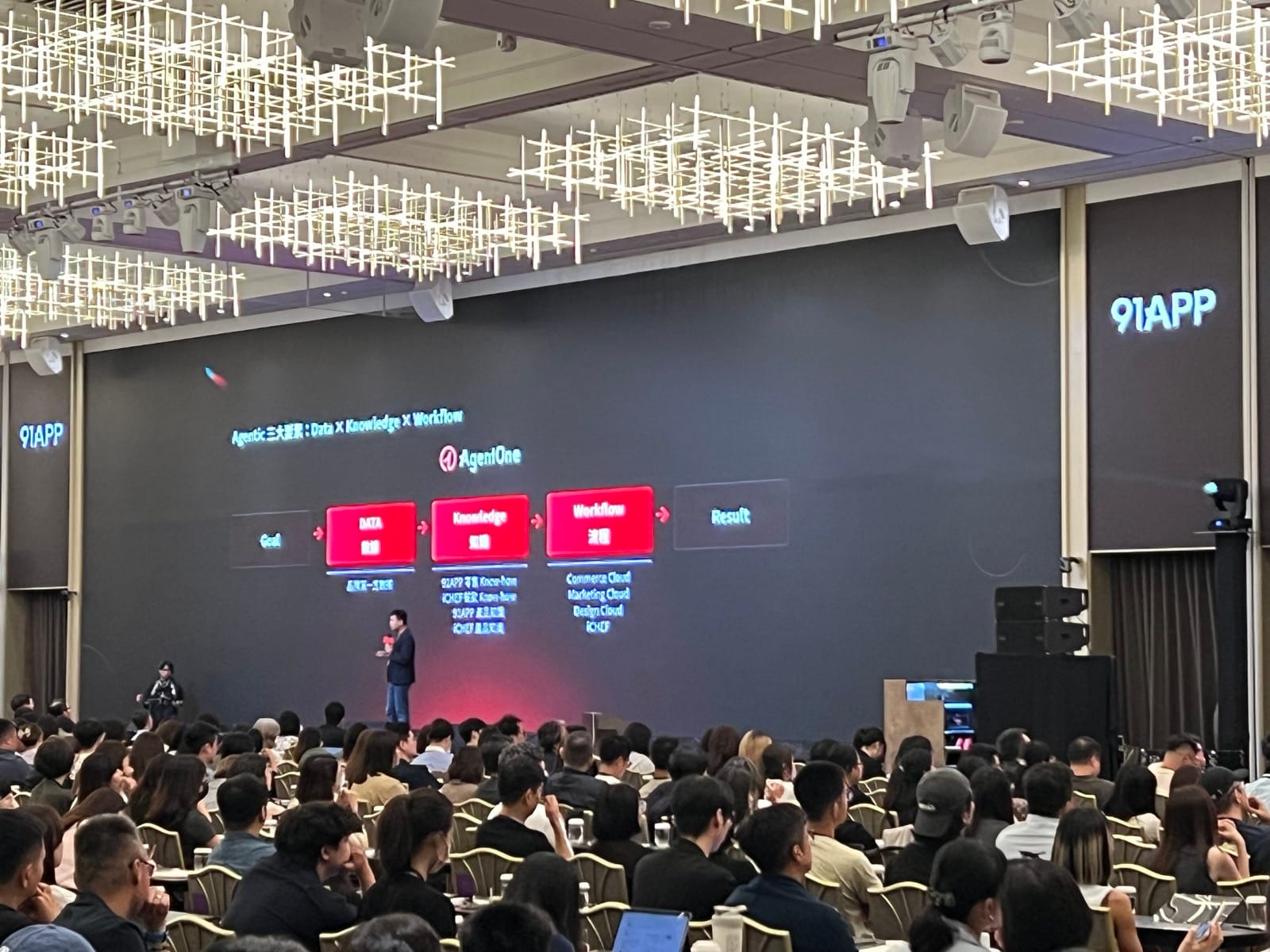
The example on stage landed hard.
A slightly deep analytics report used to take a data analyst two weeks. Now you ask AgentOne and it comes back in two minutes, and it doesn't just dump numbers on you. It draws the charts, turns Data into Information, and tells you where the insight is.
I've written before about Google turning the marketing backend from "pull a report" into "ask a question" (in Mandarin), and it's the same direction of travel. These tools were always designed for people who know how to operate tools, not for people who want an answer. That wire has finally been connected.
Lee's framing of the progression was clean. An LLM answers questions. An agent executes tasks. AgentOne goes further: it's closer to hiring a team of new colleagues who happen not to be human, pointed at a goal you set.
From Solution to Agentic: every product now takes orders from a human or an AI
This was the most important turn of the morning.
91APP has spent years building applications: commerce solutions running everything from retail to restaurants, plus martech and adtech. Those still matter. AgentOne isn't there to replace them. It sits on top and operates them.
So Commerce Solution becomes Agentic Commerce, Marketing Solution becomes Agentic Marketing, and the bundle is what they're pushing this year as Agentic Enterprise Solution.
Which means every product's design brief has changed. The UI used to accept input from humans only. Now it accepts input from humans and from AI.
Lee's "just say it out loud" demos each poked a bruise every retail operator has. Uploading products used to mean downloading a template and lining up every column before the import would take; now you throw in your own spreadsheet and it maps the fields. Member gifts, personalisation scripts, all spoken. Even the complaint that the admin panel has too many fields in type that's too small: say it, the text gets bigger.
Same logic as the Shopify agent-commerce protocol I decoded a while back (in Mandarin). The interface is being replaced by intent. You only have to say what you want.
But the thing that made me sit up straight was the demo they called the interrogation.
You can hand AgentOne a genuinely big goal, Lee said. Something like: "I want to grow new customers."
Its first move is to read your data. Then it turns around and interrogates you. Which kind of new customer do you actually mean? People who have never seen your ads? People who joined as members? Or the ones who joined and have never made a first purchase?
You pick the first-purchase group. It hands you a number: in your data, 630,000 people have signed up as members and never bought a single thing. All of them sitting in the R0 bucket, at a share high enough to be uncomfortable.
You see that number and something goes off. That is clearly a real problem.
Then it goes to the knowledge base, pulls how the products are meant to be used, how similar cases ran, even how your own brand handled it before, and comes back with a few plays and a schedule. You say "perfect, go", and it goes into Commerce Cloud, sets up the member gift, the coupons and the personalised campaign, then tracks what it produced.
This is the part that matters:
It isn't "tell it which button to press and it presses it". It runs a complete loop aimed at a goal.
Lee's verdict is one I'd sign my name to. Knowing how to operate the system is not the same as driving growth. Adopting AI was never the objective; growth is. Treat AgentOne like your marketing director, was the advice. You can ask it something as big as "how do I lift revenue" and it'll walk you through where to start.
Marketing Cloud's three agents: Paid, Owned, Earned
Then came the Marketing Cloud overhaul, which sprouted three agents in one go.
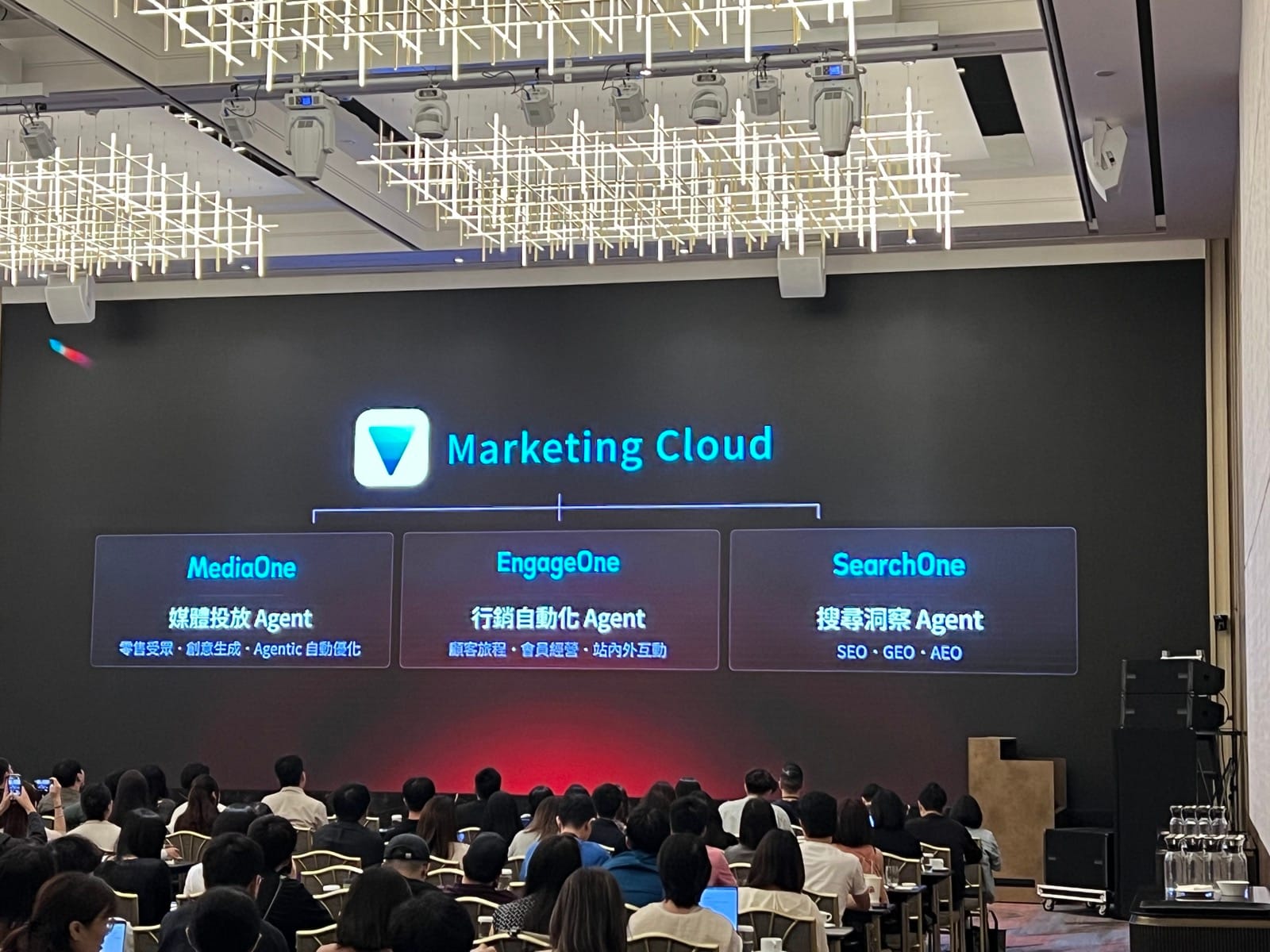
They map onto the three sources of traffic. MediaOne handles paid media, EngageOne runs owned media, SearchOne catches earned media.
MediaOne: quant trading, but for media buying
MediaOne is, on the face of it, an ad buying tool. Pick audiences, set creative, run Meta and Google Ads. There are a hundred of those. What's different?
Everything under the hood is being done by an agent.
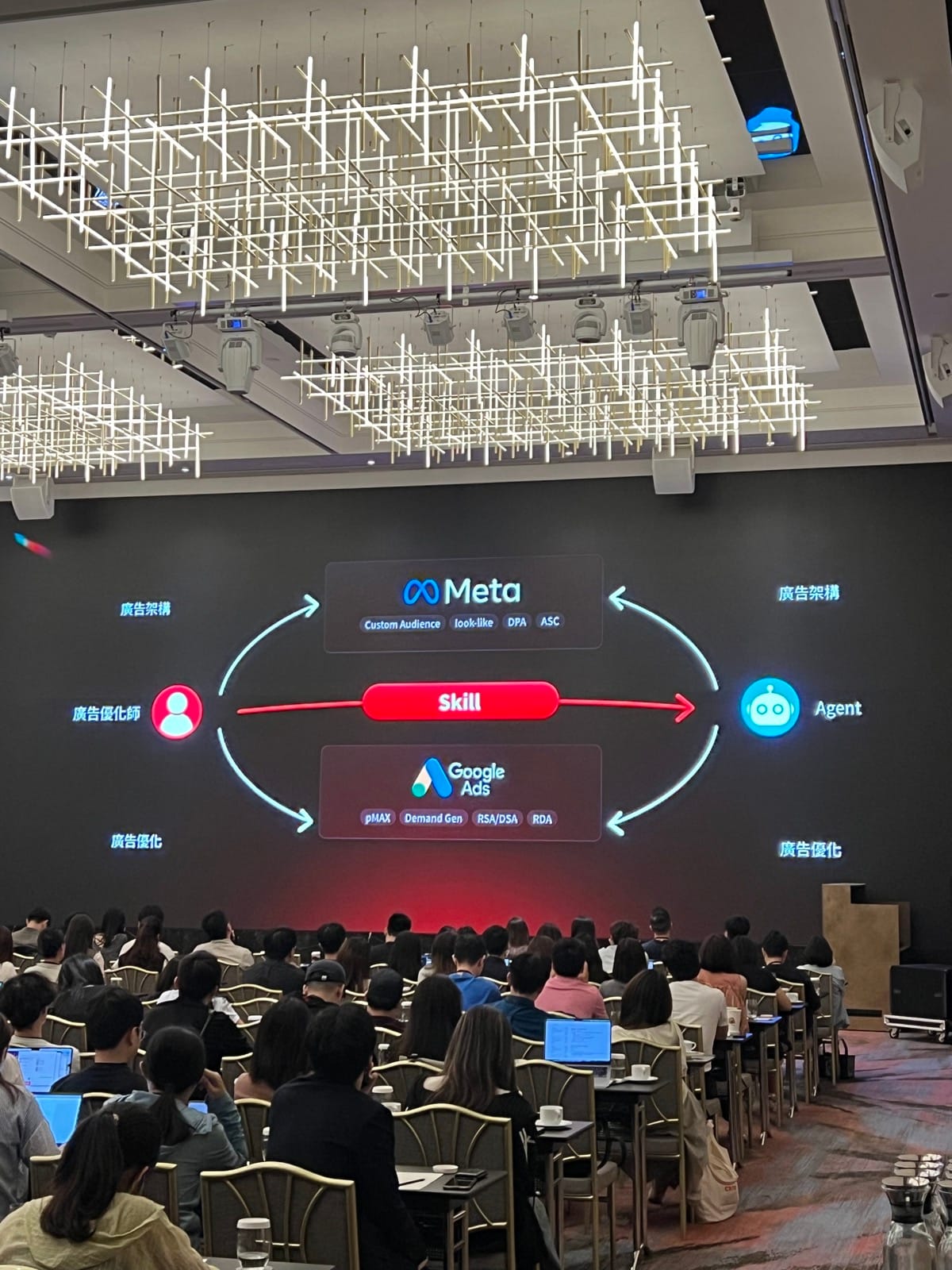
The skills inside it, Lee said, come from more than a decade of in-house retail media buyers doing the work, on the order of tens of thousands of them. A buyer used to open the Meta and Google backends, split one budget several ways, some to Custom Audience, some to Lookalike, some to ASC to optimise, then sit there scaling up, scaling down, swapping creative by hand. The agent builds that structure, optimises it, 7x24, without looking away.
The most theatrical slide of the session was this one. The agent reports what it's doing, live. This campaign isn't working, killed it. That one converts, scaled it. This audience won't budge, swapping the creative. Line by line, in front of you.
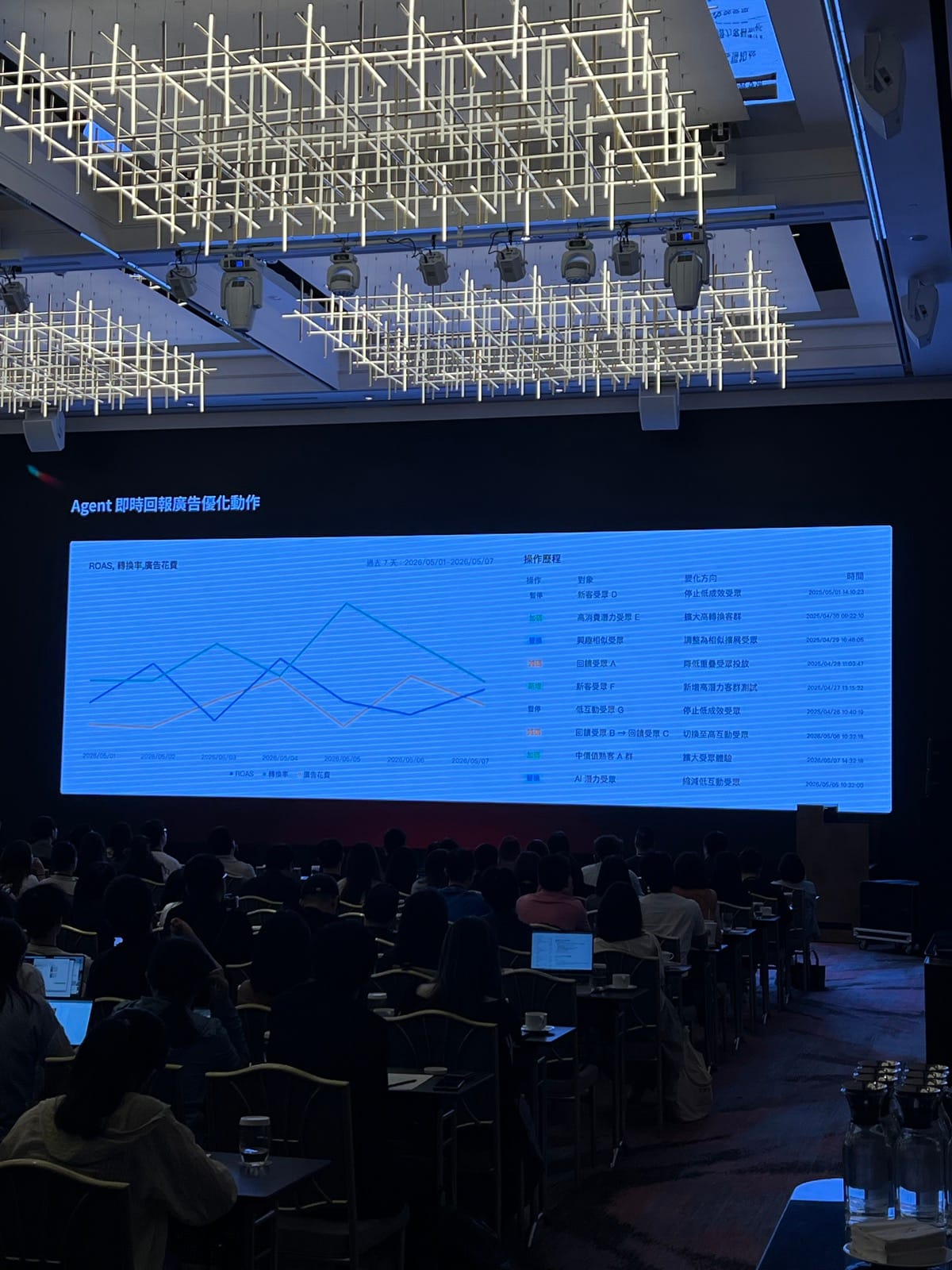
Lee gave it a precise name: quant trading for media buying. Send data up against a pair of human hands and the data usually wins. Over six months of proof-of-concept work with clients, on conversion rate, budget scale and creative usage, it beat a lot of those clients' own buyers. Short on creative? It'll generate that too.
For someone who has watched media buyers burn themselves down, this rang painfully true.
One buyer babysitting dozens of campaigns is a person running on empty. Running ads means carrying the client's stress, and people get tired, get angry, take sick days. The agent doesn't get tired. It watches hundreds of campaigns and ad sets at once and optimises fast. What it frees is the buyer's hands, tied for years to manual execution. Judgement stays with the human.
EngageOne: canvas journeys, built with you rather than by you
Canvas-style journey builders are everywhere, and the screenshots always look gorgeous. Then you ask an actual operator to draw the script node by node, and they die a slow death. 91APP's answer is blunt: put an agent on the canvas. Tell it the journey you want, it drafts it, you tell it what's wrong, you nudge the small stuff yourself. That's the collaboration.
The demo was a Double 11 VIP journey, and the numbers made the case.
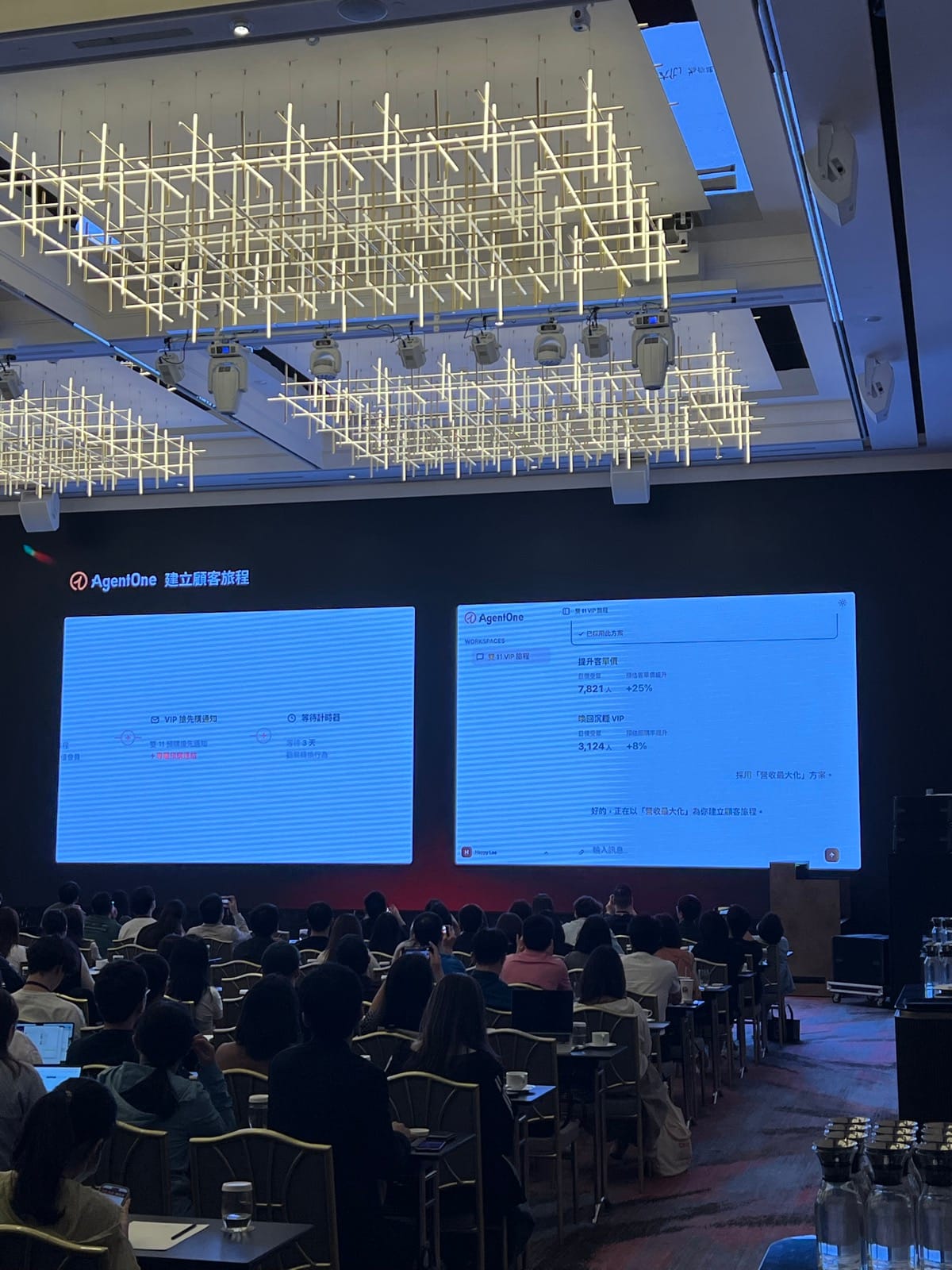
One branch pushed average order value up 25% across 7,821 customers. Another reactivated 3,124 dormant VIPs at +8%. All of it one-to-one communication built on first-party data, with the agent optimising against real results afterwards.
SearchOne: you're not growing keywords any more, you're growing questions
The third agent is the one I felt most personally, because I've spent years on SEO.
Traffic no longer arrives only through traditional Google search, so what you see in Google Search Console (GSC) isn't the whole picture any more. There's Google AI Overview, AI Mall, ChatGPT, Claude, and a growing list of other doorways.
So they built a global search insight view: traditional impressions and clicks, plus whether AI systems mention your site and whether AI crawlers come to read it, all on one screen. The spec work that makes your site legible to AI (UCD came up on stage) is built in.
The piece that made me nod hardest is AI Quest.
SEO used to be about growing keywords. In the AI era, shoppers aren't typing two words, they're asking a whole question in a full sentence. So what you grow is no longer keywords. It's key questions. I pulled this AEO (Answer Engine Optimization) and GEO (Generative Engine Optimization) shift apart in my 2026 guide to optimising for Google's AI search (in Mandarin), and it comes down to one line: you're competing for whether the AI is willing to cite you. AI Quest generates those questions and answers on your brand's behalf, and the source is refreshingly unglamorous. Every day they ask ChatGPT what shoppers in your category are asking, bring it back, and let you answer it properly on your own site.
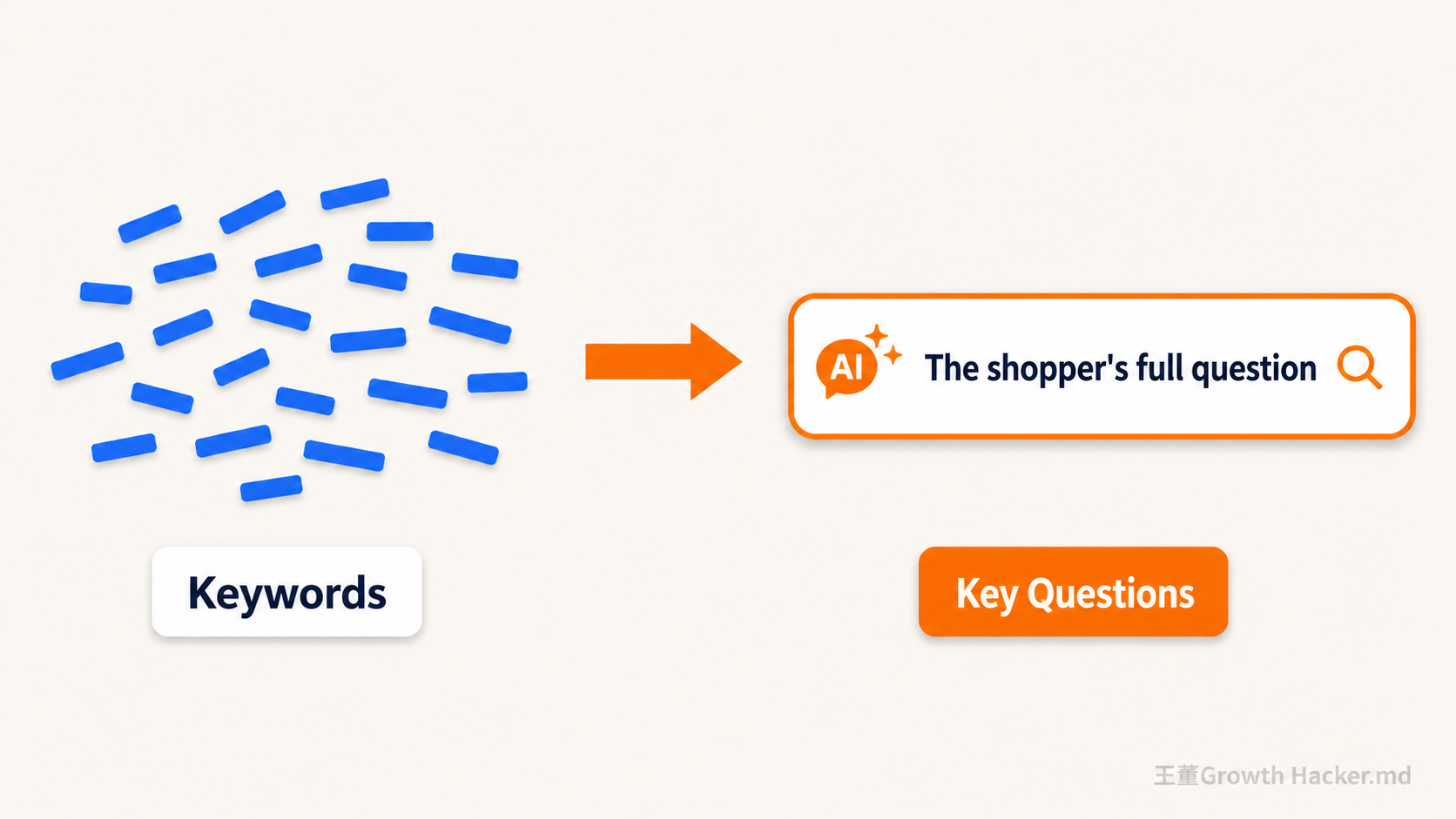
Lee added a grounded observation. GSC has started reporting AI Overview clicks. If you've done nothing about it, that line sits at zero; turn the product on and it starts to lift, small at first, but it's a start. He also warned against writing traditional search off too early. Globally it's still 70 to 80 percent or more of search volume, and on-site search is the foundation the off-site stuff is built on.
That's the product track: three foundations, three agents, a clear inventory of the weapons. The strategy track had the harder question. How does any of it collapse into the word "growth"?
The strategy track: traffic disappears, membership compounds
The strategy speaker opened with client numbers that went straight onto the first page of my notebook.
Same cohort. Sessions overall +9.1%, so the traffic opportunity is still there. New member registrations -14.5%, so new customers are leaking. Repeat purchase revenue +5%, so existing customers are still buying. And first-purchase revenue -7.6%, so the catch net for new customers has a hole in it.
His read was sharp:
The problem isn't that customers stopped coming. It's that you're not catching the new ones.
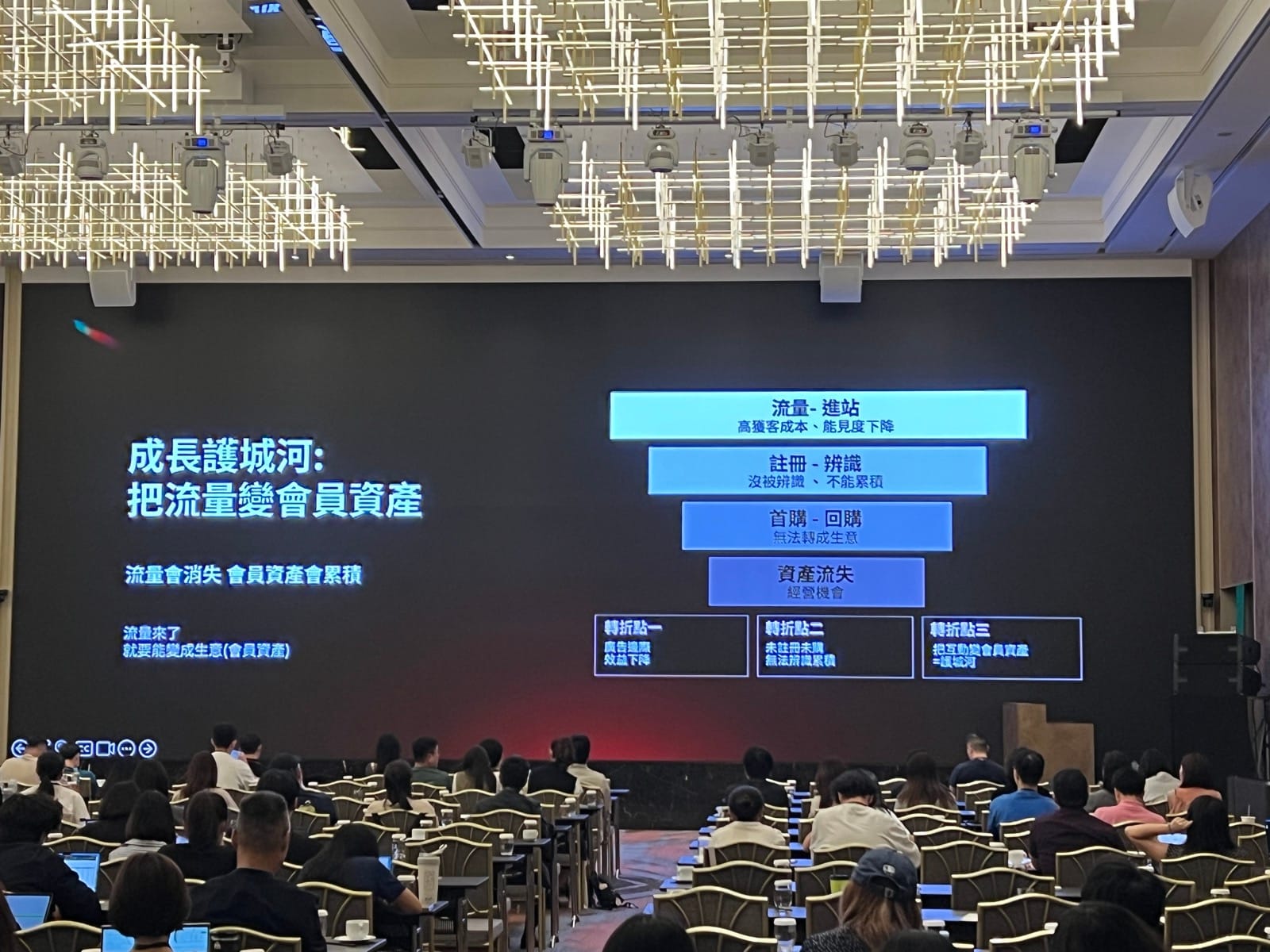
He asked the room to remember one line: traffic disappears, membership compounds. Traffic that lands and never gets identified is gone. A registration with no first purchase is value that never happened. A first purchase with no return means no relationship was built. Three inflection points sit in that funnel. One, the marginal return on ad spend is falling, so you can't keep buying your way out. Two, can you identify visitors who haven't registered and haven't bought? Three, can every interaction be recorded, identified and acted on again, so it becomes a brand asset?
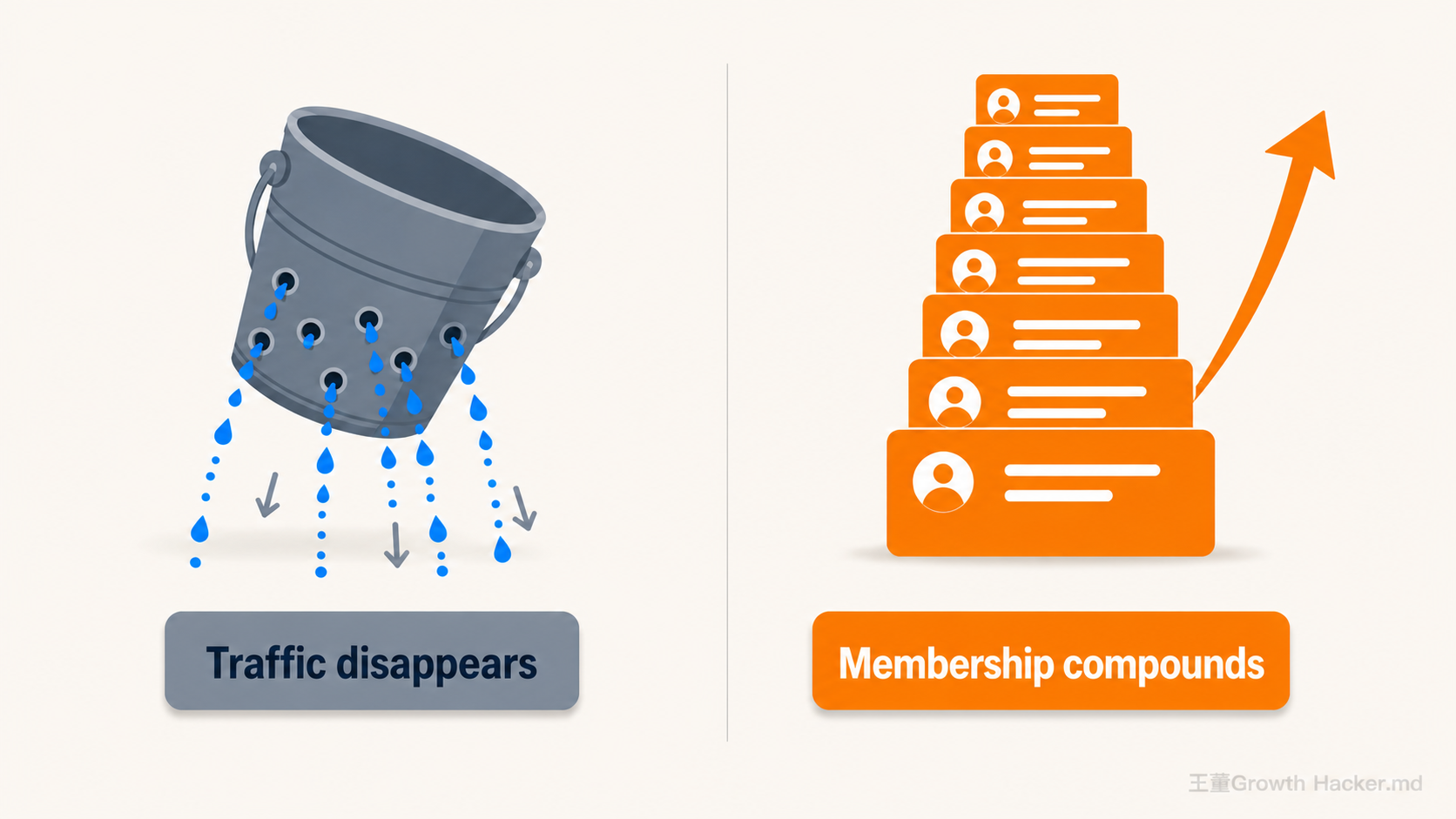
This is the same faith I argued in why first-party data, not the model, is the new moat in the AI agent era (in Mandarin). However strong the tool is, without an identifiable, workable membership base underneath it, you're doing unpaid work.
OMO 2.0: turning store walk-ins into the start of a membership asset
The strategy track then pushed OMO (Online Merge Offline) forward a version, and this went straight for my old retail-floor self.
In OMO 1.0, everyone cared about channel integration: the online-offline split, unified inventory, stitched-together transactions. In OMO 2.0 the focus shifts to accumulating membership assets. Can store traffic become a digital asset? Can the person walking past opt in? Can you raise the rate at which members bind both your app and LINE (in Taiwan, LINE isn't just a messaging app, it's the default channel almost every brand reaches customers on)? Can first purchase, repeat purchase and basket size be managed as numbers? That's what lifetime value actually means.
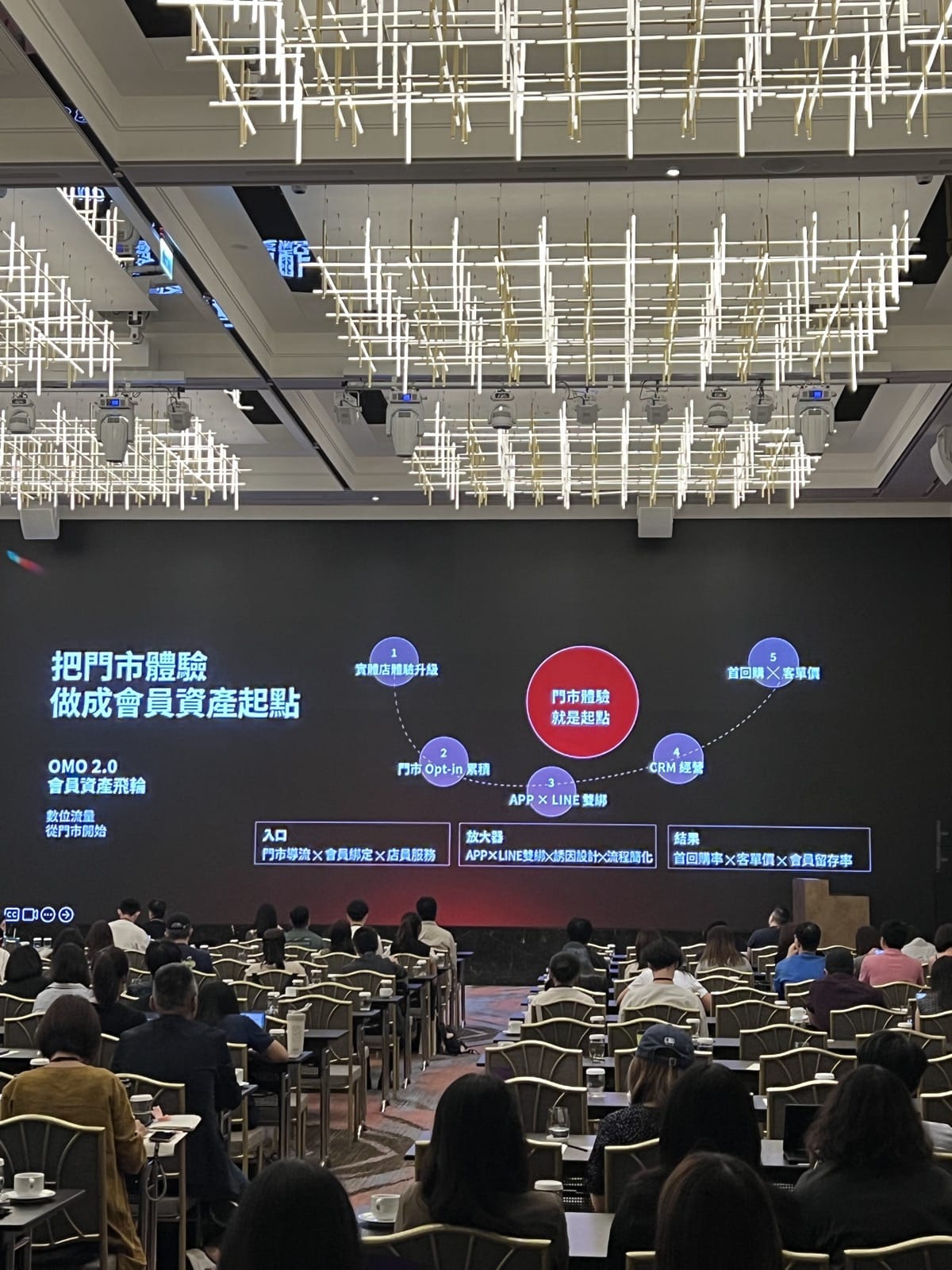
They drew it as a membership flywheel. The store supplies product, service and trust, and it's the most important starting point. Opt-in turns foot traffic into people you can identify, talk to and work with. Then app x LINE dual binding, where the app is your owned entry point and LINE is the instant-reach channel, each amplifying the other. Then CRM. Then back around to first purchase, repeat purchase and basket size.
Watching store walk-ins evaporate was the sharpest thorn of my years running a department-store concession counter, a leased sales counter inside a big retail hall.
A few hundred people would walk past in a day. They'd touch something, ask something, and leave. I didn't know their name, didn't know what they cared about, had no way to find them again. This flywheel is aimed squarely at that decades-old problem: stop letting anyone who walks in walk back out anonymously.
The speaker was honest that OMO 2.0 is far more complicated than 1.0. It has to handle acquisition, experience, conversion and retention at once, plus AI SEO, on-site search, real-time pop-up intervention, CDP, CRM, first-purchase campaigns and VIP programmes.
But the closing line was beautiful. Complexity itself isn't the problem. The problem is whether you can control it.
In an OMO 2.0 world, whoever can control complexity owns the lever on growth. That's the pitch for putting AgentOne and Commerce Cloud together, and it fits in one line: let the system take the complexity, leave the growth to the brand.
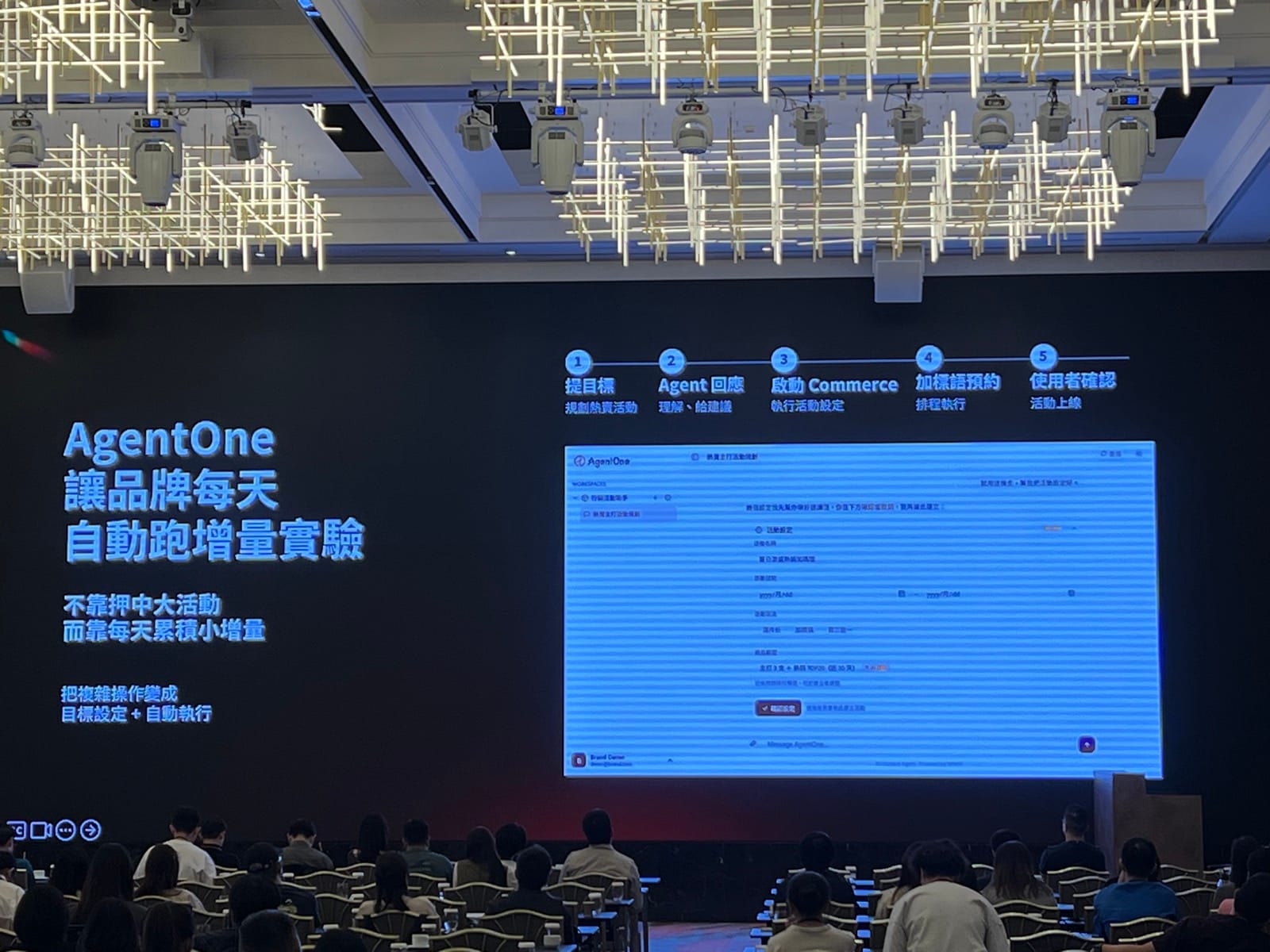
They demoed a concrete version. A brand sets the goal "lift in-store revenue". AgentOne reads the customer structure and finds an opening: a lot of online shoppers arrived through the "check store inventory" feature. It segments that group, assigns an offer, waits for your call, goes into Marketing Cloud to build the personalisation, and fires a test notification to confirm nothing breaks before going live. A tangle of OMO work compressed into a handful of simple growth tasks. Not by betting on one big campaign, but by stacking small increments daily.
Bringing it together: two wings, four integrations
The strategy track closed on an architecture that's easy to remember: two wings.
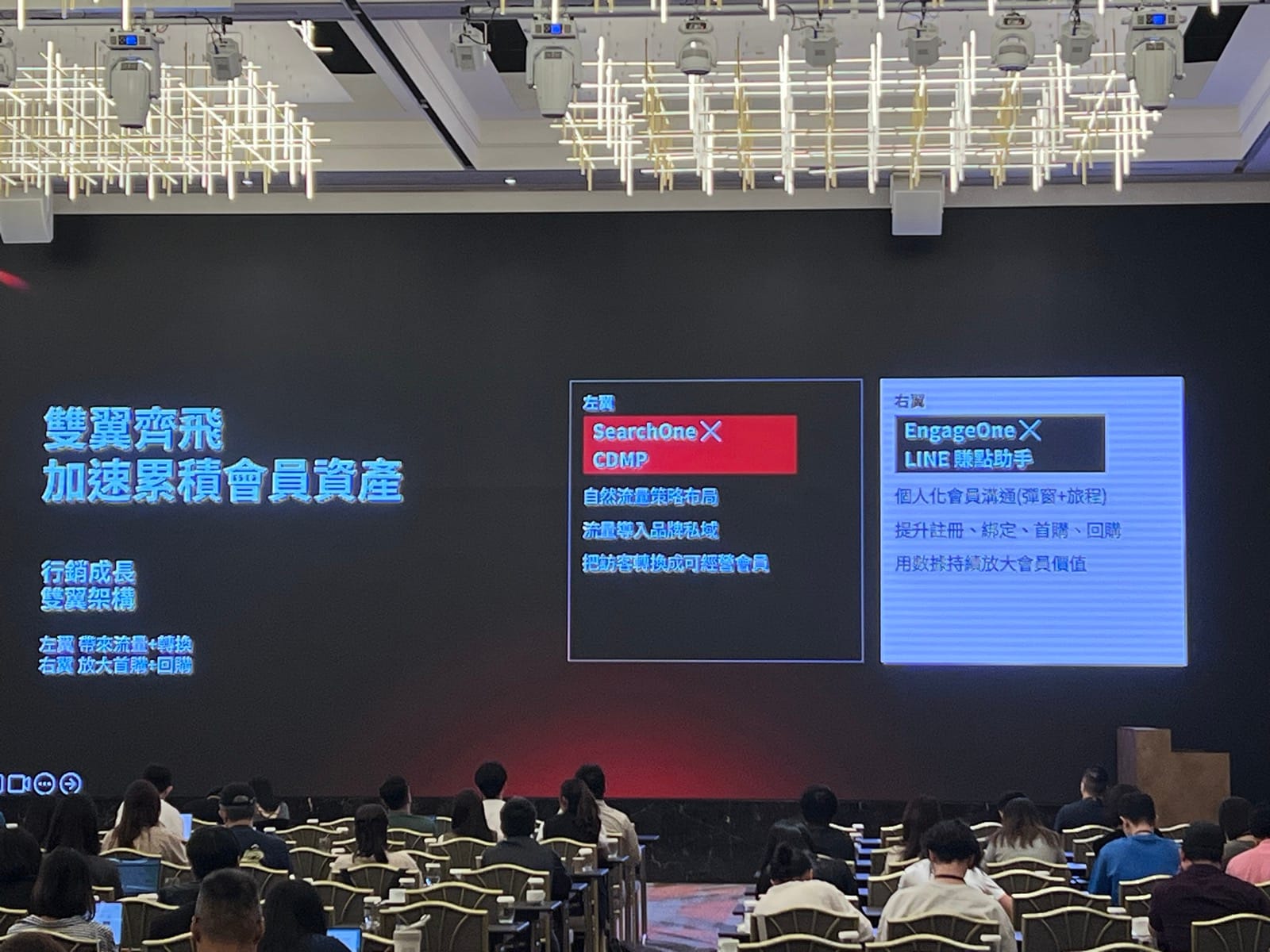
The left wing is SearchOne x CDMP (Customer Data Management Platform), bringing traffic in and converting visitors into members you can work with. The right wing is EngageOne x LINE Points Assistant (LINE 賺點助手), using points incentives to amplify first and repeat purchase. String both through AgentOne and the flywheel spins faster, producing four capabilities: be found (SearchOne), keep them (CDMP), close the sale (LINE Points Assistant), bring them back (EngageOne).
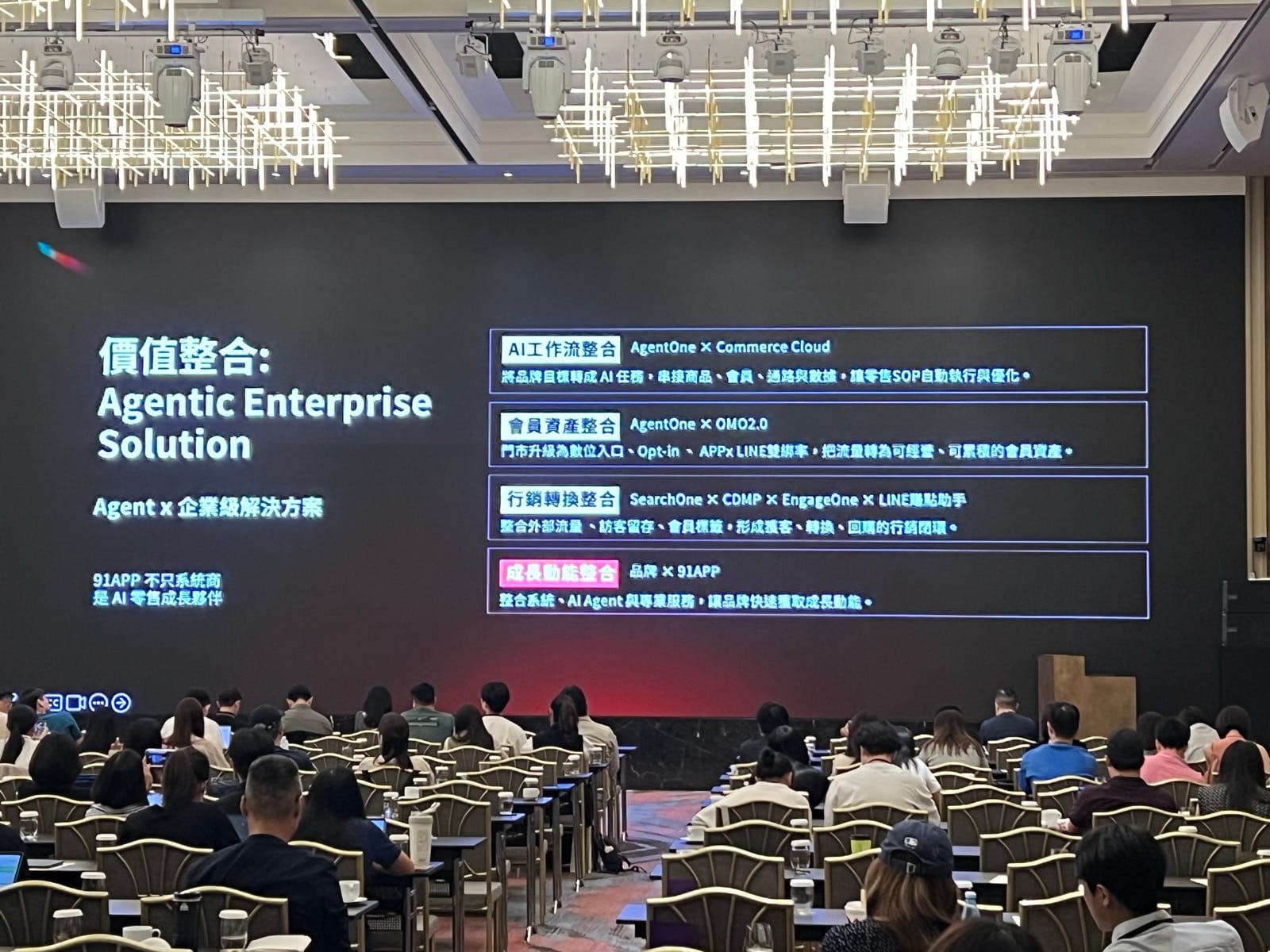
One level up, that becomes four integrations. AI workflow integration (AgentOne x Commerce Cloud, turning goals into tasks and tasks into execution). Membership asset integration (AgentOne x OMO 2.0). Marketing conversion integration (SearchOne x CDMP x EngageOne x LINE Points Assistant, catching traffic and amplifying conversion). And growth momentum integration, the brand and 91APP working as one.
There was a moment I really enjoyed. Someone from a brand raised a hand and asked the question a lot of people were sitting on: with AgentOne, do we still need an AM (Account Manager)?
The speaker didn't hedge. Absolutely you do.
Retail only gets more complicated. The more tools you have, the more you need someone who can thread them together. Brands don't want more scattered tools, they want one system that integrates the complexity and keeps generating momentum, plus service that works. The AM is the person who understands your business best.
That echoes what I wrote in my piece on the second half of the agent era (in Mandarin). Agents aren't here to replace people. They make the people who can integrate things more valuable.
So when the slogan came up, I bought it: 91APP isn't just a systems vendor, it's an AI retail growth partner.
The parts that stuck with me
"Growing keywords" becoming "growing key questions" was a smack on the head for an old SEO hand. How long since you asked what whole sentence your customer types into an AI about your category?
Store walk-ins leaking away finally has a workable path through it. That's the problem I couldn't crack back on the counter.
One buyer holding dozens of campaigns until they break is real, and quant trading is an honest answer to it. Judgement at the strategy layer, execution to something that doesn't get tired.
And the most important line of the day: knowing how to operate something isn't the same as growing something. Swap "AI" for any tool you've ever rolled out and it still holds.
If you want the implementation detail
91APP followed the launch with an online theme week on this new tech (新科技線上主題週) that goes deeper into everything above.
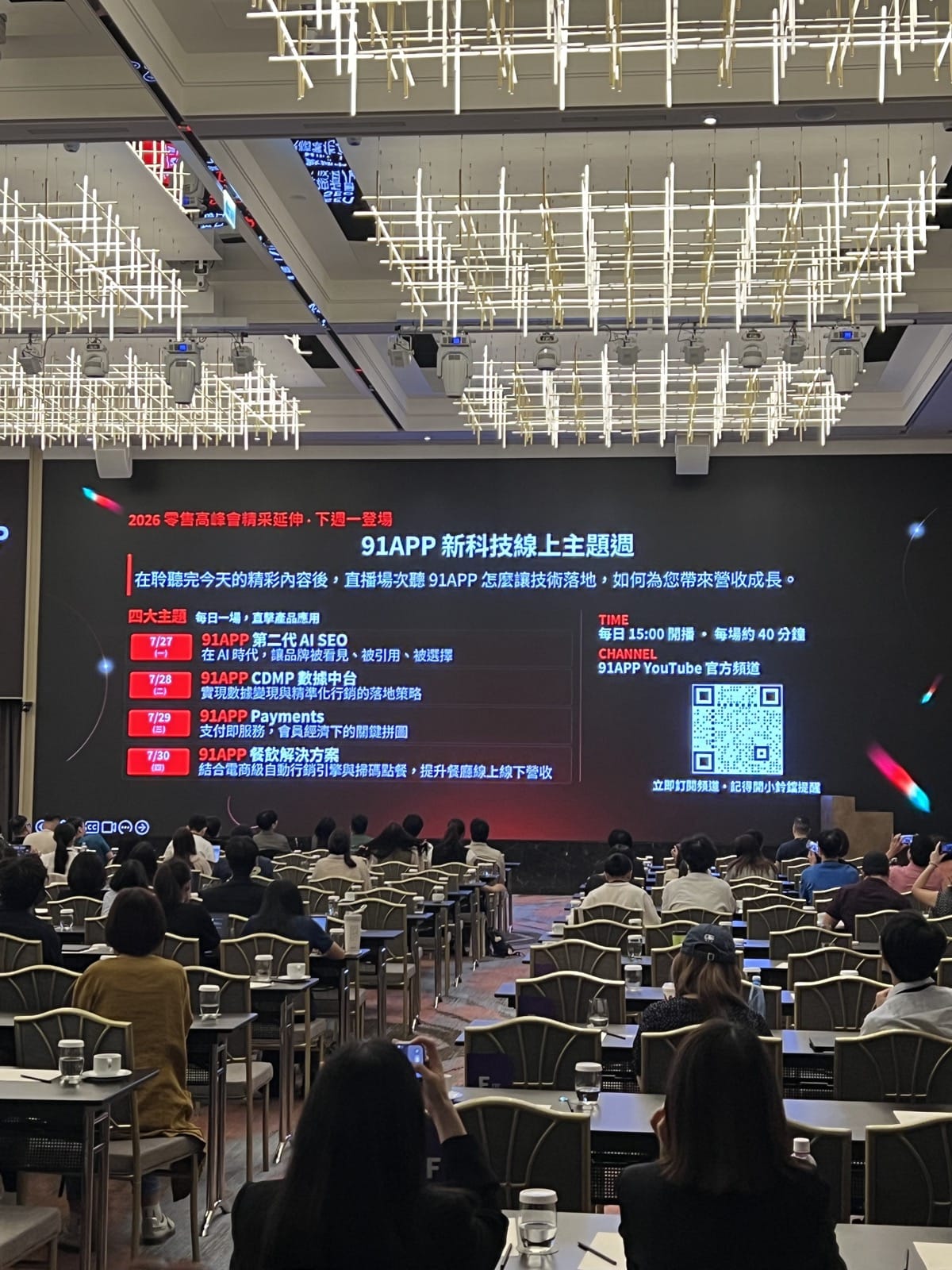
Four sessions, 3pm daily on 91APP's official YouTube channel, roughly 40 minutes each. Monday 27 July was second-generation AI SEO, Tuesday 28 July the CDMP data platform, Wednesday 29 July Payments, and F&B solutions closes it out today, Thursday 30 July. The first three are already up as replays. One flag for readers outside Taiwan: all four are in Mandarin, no English track. Pick whichever hurts most. It'll be more practical than this post.
To shore up the OMO and membership fundamentals first, I've written about how Japanese retailers run OMO, and the four things that matter in retail apps and membership (in Mandarin).
Five things you could start on this week
► Break the first-purchase funnel apart. Track new registrations, first purchases and repeat purchases as three separate numbers instead of staring at total traffic. Your traffic might still be growing while new customers slip through your fingers.
► Upgrade from keywords to key questions. Ask ChatGPT what shoppers in your category are asking, then check whether your site answers any of it properly.
► Stop treating the store as a checkout. Work out how a walk-in opts in and how the app and LINE get bound together, so every visit becomes a membership asset.
► Start from the goal, not the feature. Ask what growth outcome you want the AI to deliver, not whether it can operate a particular backend.
► Don't rush to cut headcount. The more tools you add, the more you need someone who can connect them. Your AM gets more valuable here, not less.
You don't have to do all five. Pick one this week. I'd start with the first-purchase funnel or with store opt-in, because those two are most likely hiding a leak you haven't noticed.
AI was never the point. Growth is. That's what the launch was saying from start to finish, and I've passed it on as I heard it.
Disclosure and Disclaimer
This article was put together by 王董 (Wang Dong) working with AI. Any third-party data, research or tools cited here are named; where the original source has a public link, it is attached in the form [source name](URL) so you can look it up yourself. If anything here differs from the original source, treat the original as authoritative.
The content is for reference and discussion only. It does not constitute professional, business or investment advice. Judge it against your own situation and take responsibility for your own actions. Tool features, figures and platform policies mentioned here may change over time, so always check the latest official announcements.
The views expressed are the author's own and do not represent the positions of the author's employer, clients or partners.
All figures and quotes in this article come from what was shared on stage at the 91APP AgentOne launch (July 2026); the slides and talks as presented are the reference.